

Reglamento internacional
*El objetivo de este artículo es meramente informativo y no tiene ninguna validez oficial. Solo busco dar más información y contexto sobre los cambios que hemo hecho en el reglamento español en derrapes e intento explicarlo de forma simplificada, dando en ciertos momentos mi opinión. Si quieres consultar los documentos oficiales puedes hacer clic en los enlaces que hay a lo largo del artículo
En este artículo me quiero centrar principalmente en el reglamento español, pero para tener contexto sobre el porqué de los cambios que hemos introducido en España, hay que tener en cuenta el reglamento internacional. Además de que este es el que se sigue usando en el resto del mundo.
Puedes ver el reglamento internacional completo aquí.
¿Por qué tenemos un reglamento de derrapes diferente en España?
Nuestra disciplina, como la mayoría de los deportes, evoluciona y cambia con el tiempo y, aunque a nivel internacional el reglamento se ha mantenido invariable desde 2020, en España hemos visto la necesidad de ampliar y especificar ciertas partes de la disciplina de derrapes acordes a las necesidades actuales, además de mejorar apartados que eran ambiguos.
Todos estos cambios en el reglamento y la matriz se han hecho de tal forma que en todo momento haya un razonamiento detrás de cada decisión y se pueda explicar el porqué de todo lo que se ha cambiado. Además, el objetivo con este reglamento es mantener la esencia de cómo se juzga, solo que se busca que desaparezcan las ambigüedades con los cambios que se han añadido y se busca que sea objetivo gracias al programa informático que se ha creado para juzgar. Porque al final un juez debería ser una herramienta que se encargue de aplicar el reglamento, no debería poder tener opinión porque una competición debe dar el mismo resultado lo juzgue quien lo juzgue siempre que esté acorde al reglamento aplicado.
Incongruencias en la matriz internacional
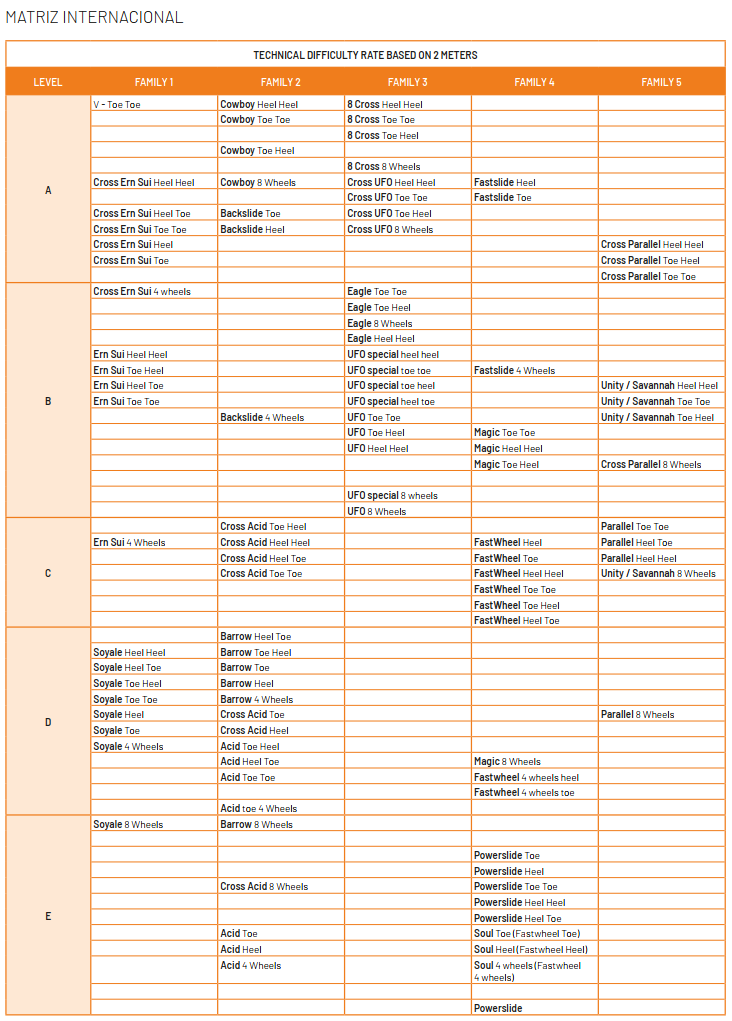
Si observas la matriz internacional verás que hay muchas cosas que no terminan de cuadrar:
- En primer lugar están las familias: Más o menos tienen sentido cómo están separados los derrapes, pero hay algunos detalles que echan a perder el enfoque de esta matriz.
- En la familia 5 tenemos el Parallel y Cross Parallel (trucos donde ambos pies derrapan) junto con el Unity y Savannah (trucos con el pie de delante derrapando y el pie de atrás frenando). A mi parecer ahí sobra el Parallel porque el pie principal en ese derrape es el de delante, que va en canto interno, mientras que en los otros tres el pie principal va en canto externo, pero quizá podría llegar a entenderse y pensar una razón en la que los cuatro derrapes tengan sentido juntos. Sin embargo, lo que no tiene sentido es que se ponga en familias diferentes al Unity / Savannah y al Acid / Cross Acid, cuando los primeros surgen directamente de los segundos. Al igual que colocar al Parallel en una familia diferente del Soul y Powerslide.
- Creo que la idea a la hora de separar los derrapes por familias debería ser que los derrapes de cada familia tuvieran una característica en común y única de esa familia, además de que la técnica de derrapes más sencillos de cada familia se pueda usar para derrapes de mayor de esa misma familia.
- Nivel de ciertos derrapes: La otra incongruencia que veo en la matriz internacional es a la hora de comparar la dificultad de ciertos derrapes. Pongo ejemplos:
- Hay derrapes que están muy seguidos independientemente del número de ruedas: El Águila flat está puesto como más difícil que el Águila talones y a una y dos líneas de las otras versiones del Águila a dos ruedas; lo mismo sucede con el Cross Sui en 5 ruedas y las versiones a 2 ruedas, que están todas seguidas, o con el Cowboy o Cross UFO, donde la versión en flat está a solo a una o dos líneas de la primera versión a 2 ruedas. Esto sin contar con la pregunta de si deberíamos separar en diferentes líneas las diferentes versiones de 2 ruedas de los derrapes. En algunos derrapes pienso que está claro que cierta combinación de ruedas es más difícil que otra, pero en la mayoría de los casos depende más de la persona que del derrape en sí, y no creo que haya suficientes evidencias como para separar esas versiones, además de que dificultan la lectura y el entendimiento de la matriz.
- Hay derrapes que NO son más difíciles que otros: El caso más obvio es el del Magic y el Parallel. Por la posición de los pies de ambos derrapes queda claro que el Magic es más sencillo porque al tener los dos pies inclinados hacia dentro (es decir, cada pie inclinado hacia un lado) es mucho más difícil caerse hacia atrás si colocas el cuerpo muy atrás además de que la superficie de apoyo es mucho mayor porque los pies están más separados. Sin embargo, en el Parallel se inclinan los dos pies hacia el mismo lado (derrapando así los dos pies en canto interno delante y canto externo detrás) y tienen que estar los pies más juntos entre sí. Esto hace que si inclinas demasiado los pies o echas el cuerpo demasiado hacia atrás, te quedes sin apoyo donde dejar el peso y te caigas. Esto se “podría defender” diciendo que no se puede comparar el nivel de dificultad entre una familia y otra, pero sinceramente, ¿qué sentido tiene entonces hacer una matriz con varias familias si no se pueden comparar todos los derrapes entre sí?
- Sucede algo parecido y dentro de la misma familia con el Cross UFO flat y el Águila a 2 ruedas, por poner un ejemplo.
- La matriz está basada en derrapes de 2 metros, que es el mínimo, pero pienso que derrapar 2 metros de cualquier derrape no demuestra dominio ni control sobre este.
Matriz española y razonamiento
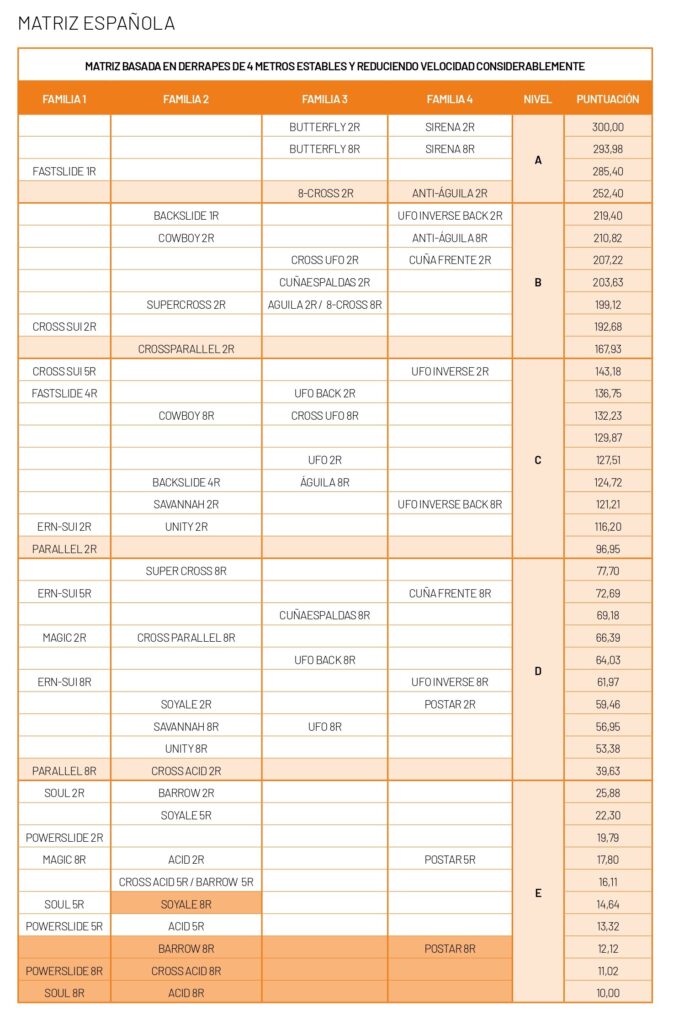
El año pasado (2024) se cambió la matriz española y se creó una matriz con solo 4 familias. Cada familia tiene una razón de ser:
- La familia 1 es para derrapes que se hacen de lado con el pie principal o dominante derrapando en canto interno.
- La familia 2 es para derrapes que se hacen de lado con el pie principal derrapando en canto externo.
- La familia 3 es para derrapes ejecutados con el cuerpo de frente, ya sea hacia delante o hacia atrás, y con las piernas abiertas (flexibilidad de abrir la cadera).
- La familia 4 es para derrapes frontales con las piernas cerradas (flexibilidad para cerrar la cadera).
Mientras que hemos separado cada familia en 5 niveles de dificultad, haciendo coincidir cada salto de nivel con una subida considerable en el nivel de los derrapes ejecutados (se puede ver esta subida no lineal de dificultad observando la puntuación, pero pienso que explicar el valor de esas puntuaciones es demasiado técnico a nivel matemático). La dificultad no sigue un incremento lineal porque a partir de ciertos derrapes o ciertos conocimientos no siempre cuesta el mismo esfuerzo aprender el siguiente truco.
De esta forma, en el nivel E están todos los derrapes considerados básicos a 8 y 5 ruedas, y la mayoría también a 2. En el nivel D habrá ya derrapes sencillos (que no básicos) a 8 ruedas y el resto de básicos a 2. En el nivel C puedes encontrarte derrapes de dificultad intermedia (Back, Fast, Cross Sui, Águila, Cowboy) y las versiones a 2 ruedas de derrapes sencillos (Unity, Savannah, UFO, Parallel). En el nivel B están derrapes difíciles y, por último, en el nivel A están los derrapes que tienen una dificultad muy alta, ya sea debido a su flexibilidad y/o a su dificultad técnica.
Además, si estás aprendiendo a derrapar, te puedes basar en esta matriz para ver qué trucos tiene sentido aprender a partir de los derrapes que ya sabes hacer. Por ejemplo, si no sabes hacer un Acid a 2 ruedas no te recomiendo en absoluto intentar aprender un Unity a 2 ruedas, por mucho que ya sepas hacer un Unity flat, porque el Unity a 2 ruedas está muy influenciado pero estos dos derrapes anteriores.
Por otro lado, las versiones a 2 ruedas de cada derrape están todas juntas, acorde a la explicación que he dado en el apartado anterior.
Por último, está matriz está basada en derrapes de 4 metros en suelo deslizante suponiendo que mantienes el cuerpo y brazos controlados durante la ejecución y donde reduces la velocidad considerablemente llegando a casi pararte, ya que se ha considerado que con estos criterios necesitas tener cierto dominio de ese derrape.
Reglamento español
Para no extenderme más de lo necesario no voy a comparar esta vez ambos reglamentos como hice con las matrices, sino que solamente voy a explicar el reglamento español. En cualquier caso, puedes leerte las 4 páginas que tiene el reglamento internacional en el apartado de derrapes (apartado 9) para ver luego aquí las diferencias. En cualquier caso, repito, lo aquí descrito tiene solo carácter divulgativo y en ocasiones aporto y he aportado mi opinión. No tiene ninguna validez oficial y solo busco que sea más sencillo de entender.
Si vas leyendo cada punto del reglamento, los primeros 4 hacen referencia al área de competición, la composición de los grupos, el desarrollo de la prueba y el best slide. Como estos apartados no tienen tanto que ver con la parte técnica y ya están resumidos en el libro no voy a repetir lo mismo aquí.
Requisitos técnicos y programa para juzgar
Como comento en el libro, a partir de 2025 en España se va a juzgar con un programa que da valores numéricos a las actuaciones de los participantes. De esta forma, los patinadores de un mismo grupo ya no serán comparados, sino que serán puntuados numéricamente y clasificados a partir de estas puntuaciones.
Para juzgar cada uno de los derrapes se van a valorar varias características de cada derrape, pero antes voy a definir lo que es un derrape estándar, ya que la puntuación de cada derrape en la matriz viene dado acorde a estos valores y a partir de ahí se bonificará o deducirá puntuación acorde a esos criterios.
Se considera que el derrape es estándar cuando se realiza durante 4 metros (si es un combo, la longitud estándar es de 3 metros de cada uno de los derrapes) estable en cuerpo y pies, se va en línea recta y se reduce considerablemente la velocidad, parándose prácticamente al final. Esto quiere decir que la posición del cuerpo, pies y trayectoria no tendrá bonificación, ya que se busca que esta sea siempre correcta.
Una vez explicado, detallaré cada una de las características:
- Posición del cuerpo: Tanto pecho como brazos deben permanecer estables durante la ejecución del derrape. Se definen 3 posibles estados:
- Buen control del tronco (B): es cuando se mantiene la misma posición durante todo el trascurso del derrape.
- Control del tronco superior regular (R): es cuando tras la entrada al derrape se mueven los brazos o el cuerpo de forma errática.
- Mal control del tronco (M): cuando tras entrar al derrape se mueves los brazos y el cuerpo de forma errática.
- Trayectoria del derrape:
- Bien (B): el derrape se ejecuta en línea recta.
- Regular (R): cuando el derrape es de 5 o más metros y se desvía hasta el extremo lateral de la pista, o cuando tiene menos de 5 metros y realiza una trayectoria curva.
- Mal (M): cuando el patinador se ve obligado a terminar el derrape porque se sale de la pista por un lateral o cuando la trayectoria del derrape tiene menos de 5 metros y se desvía al extremo lateral de la pista.
- Posición de los pies: Presta atención a la colocación de los pies y a las dudas que puedan surgir en el canto durante la ejecución. Tenemos también 3 opciones:
- Bien (B): los pies están en la posición del derrape y este se identifica claramente, además de que hay bloqueo entre las piernas si debe haberlo.
- Regular (R): se da cuando el derrape es a 2 ruedas y un pie apoya más ruedas momentáneamente una o dos veces; o cuando las piernas no van bloqueadas en derrapes que deben estarlo; o cuando el pie bota, pero se ve claramente que la inclinación del patín es la correcta.
- Mal (M): cuando el derrape es a 2 ruedas y un pie apoya más ruedas momentáneamente más de dos veces o se queda a más de dos ruedas durante un metro o más; cuando el pie bota y/o no está claro el canto que lleva el patín que derrapa o frena.
- Parada: la parada demuestra una mayor habilidad y control y, como en las características anteriores, se definen 3 opciones:
- Full Stop (F): aporta una bonificación cuando se para en la posición del derrape y se mantiene esta durante al menos un segundo.
- Stop (S): no modifica la puntuación del derrape ya que es lo que se considerará como estándar. Será “stop” cuando se reduzca la velocidad considerablemente, sin llegar a hacer un “Full Stop” y el patinador al finalizar el derrape no continua su trayectoria hacia delante, es decir, sale por el lateral de la zona de derrapes patinando.
- Non-stop (N): se le otorga una deducción cuando termina el derrape de manera abrupta y/o sale de este todavía con velocidad e impulso hacia delante. También se considera “non-stop” si finaliza el derrape fuera de la zona de derrapes.
- Longitud: la distancia mínima para que un derrape sea válido es de 2 metros y solo se tendrá en cuenta la distancia derrapada en la zona de derrapes. Aquí diferenciaremos entre derrapes individuales y derrapes dentro de un combo:
- Derrapes individuales: si se realizan 2 o 3 metros, al ser menos que lo establecido como estándar, tendrá una deducción; 4 y 5 metros derrapados se considerará como estándar y no sumará ni restará puntuación; mientras que derrapes de más de 6 metros tendrán una bonificación.
- Derrapes dentro de un combo: en este caso hay penalización si ese derrape dentro del combo hace 2 metros. Si hace 3 metros será lo estándar, y si hace 4 o más metros tendrá una bonificación.
A continuación adjunto imágenes con las tablas de las bonificaciones y deducciones de las que acabo de hablar.
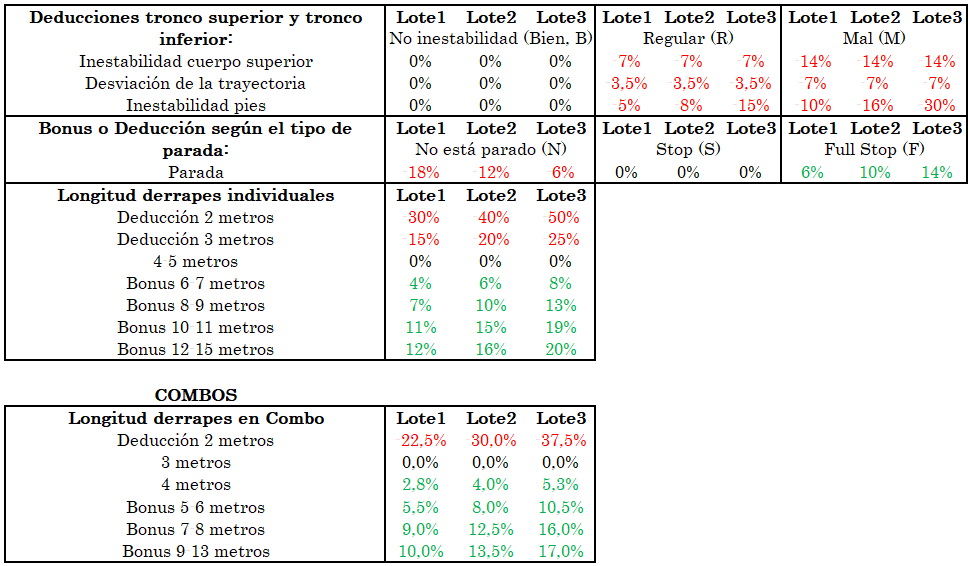
Si las observas podrás ver que el porcentaje varía dependiendo del lote, pero… ¿qué es un lote?
Lotes
Como cada derrape tiene su propia posición, no todos los derrapes son igual de fáciles o difíciles de parar, de hacer más largos, o de colocar la posición de los pies correctamente, por lo que para cada una de estas tres características se han separado los derrapes en 3 lotes, cada uno con su explicación.
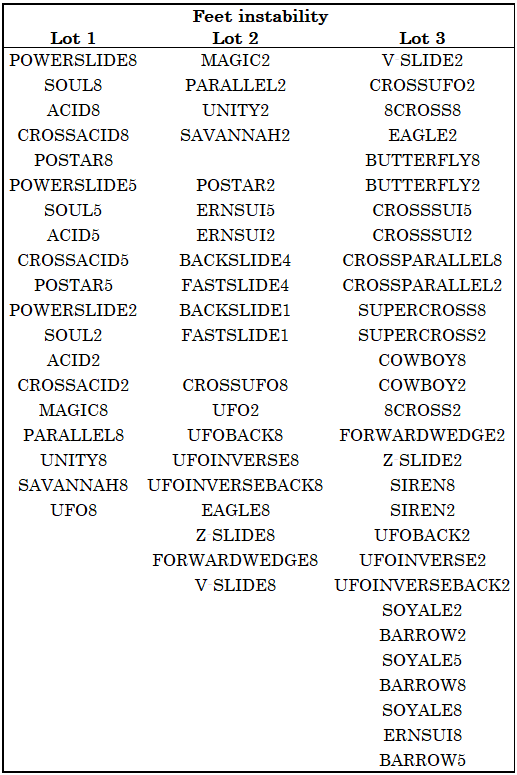
Para la inestabilidad de los pies, los derrapes que hay en cada lote responden a las siguientes definiciones:
- Lote 1. Derrapes donde un pie patina y/o el derrape se realiza a 8 ruedas (si no hay dudas con el canto).
- Lote 2. Derrapes a 8 ruedas donde la flexibilidad puede provocar que esté mal la posición de los pies, y lo que no cumple el criterio 1 ni el 3 (sobre todo derrapes a 2 ruedas) o cumple cosas del 1 y del 3.
- Lote 3. Derrapes en los que es difícil definir el canto o que pueden crear muchas dudas sobre la posición de los pies.
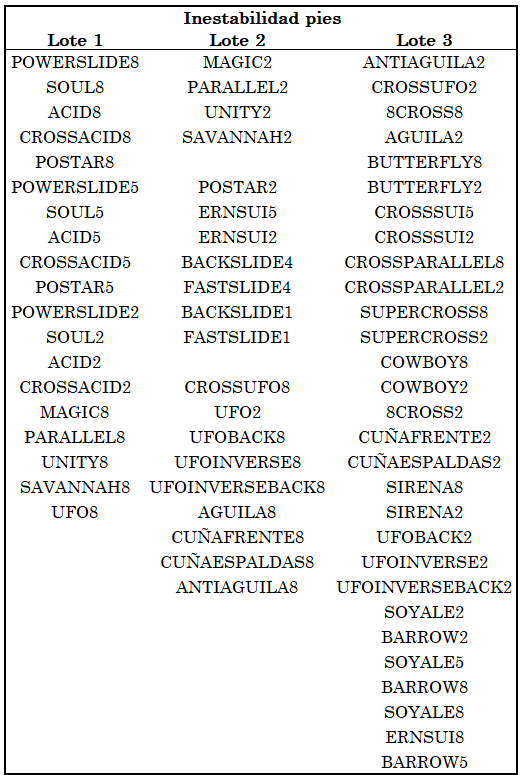
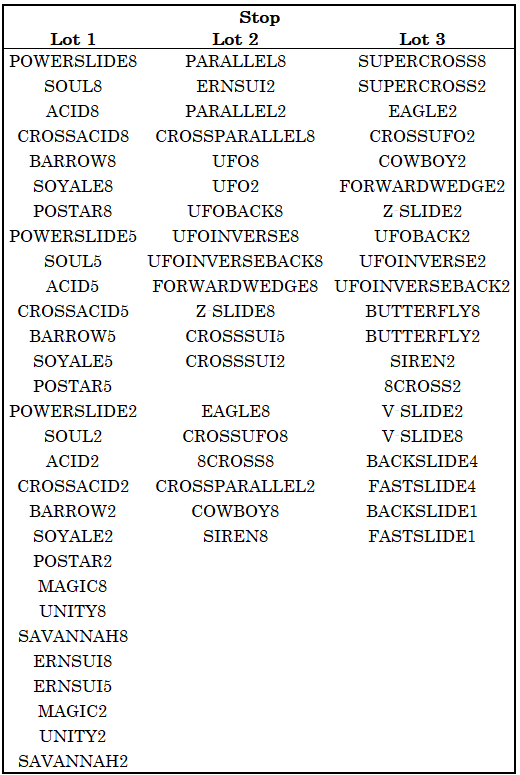
Para la parada, definimos los siguientes 3 lotes:
- Lote 1. Derrapes en los que un pie patina o derrapes realizados a 8 o 2 ruedas donde cada pie está inclinado hacia un lado.
- Lote 2. Derrapes a 8 ruedas donde se requiere de bastante flexibilidad y derrapes a 8 o a 2 ruedas con ambos pies inclinados hacia el mismo lado, y el resto de derrapes que no cuadran en los otros dos lotes.
- Lote 3. Derrapes que se realizan a 1 pie; que se realizan con los pies colocados al mismo nivel, es decir, en una sola línea; a 2 ruedas con dificultad para mantener la posición quietos y/o que para realizarlos hay mucha flexibilidad involucrada.
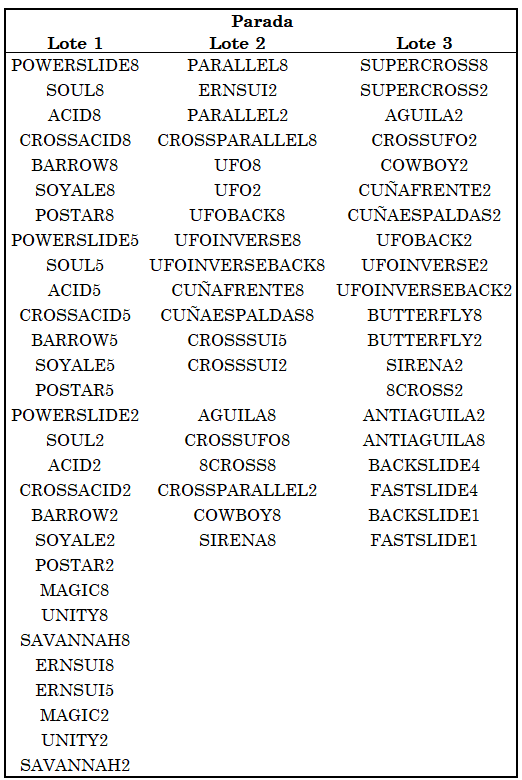
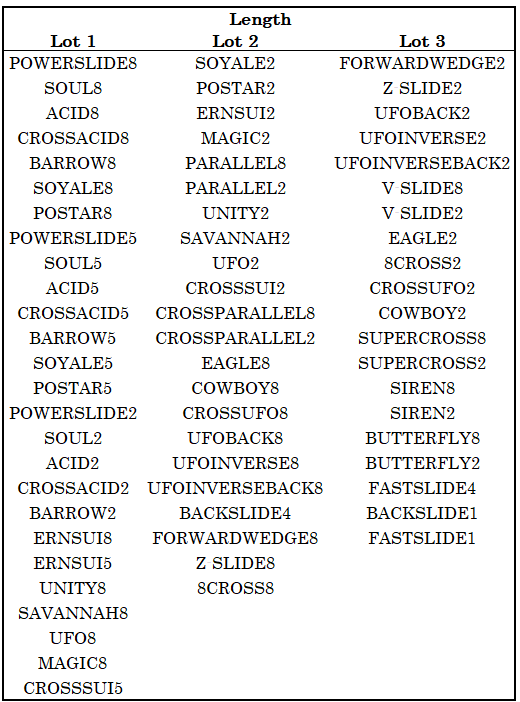
Para la longitud definimos los siguientes 3 lotes:
- Lote 1. Derrapes en las que un pie patina o figuras realizadas a 8 ruedas donde cada pie está inclinado hacia un lado.
- Lote 2. Derrapes a 2 ruedas con un pie inclinado hacia cada lado; derrapes con un pie patinando a 2 ruedas y difícil de mantener; derrapes a 8/4 ruedas con todos los pies inclinados hacia el mismo lado.
- Lote 3. Derrapes ejecutados a 1 rueda; derrapes a 2 ruedas que por su posición o flexibilidad contraria a la posición natural del cuerpo son difíciles de mantener; o figuras a 4/8 ruedas que requieren de mucho equilibrio para ser mantenidas y solo hay una línea de apoyo.
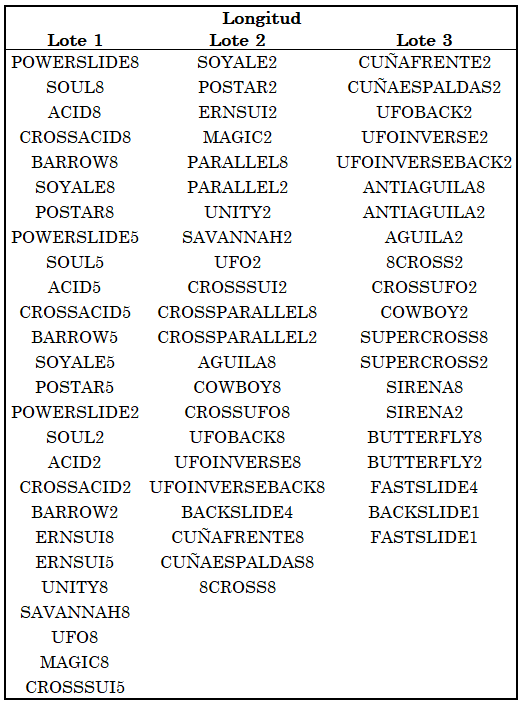
Combos
Por último, hay que dedicar un apartado extra para hablar de los combos y sus particularidades a la hora de juzgarlos. Como ya hemos mencionado, se considera un combo cuando cada derrape que lo compone tiene mínimo 2 metros (3 metros será lo considerado como estándar) y la transición entre ambos es menor a 2 metros.
Para calcular la puntuación de un combo primero deberemos obtener la puntuación base, y luego aplicar las deducciones. Solo que en este caso sucede de forma ligeramente diferente. Para ellos, realizaremos los siguientes pasos:
- Para ello, usaremos como referencia la puntuación base del derrape individual más alto.
- Buscamos la diferencia de nivel (número de filas) entre el derrape más alto y el más bajo, Dependiendo del número de filas que haya cogeremos el factor que corresponda acorde a la siguiente tabla:
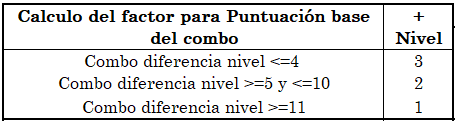
3. A este valor le sumamos 0,5 si el combo es ascendente (el derrape realizado en primer lugar está más abajo en la matriz que el segundo derrape) o le restamos un 0,5 si es descendiente (el derrape realizado en primer lugar está más arriba en la matriz que el segundo).
4. Ahora buscamos el nivel de dificultad del derrape de menor dificultad en la siguiente tabla.
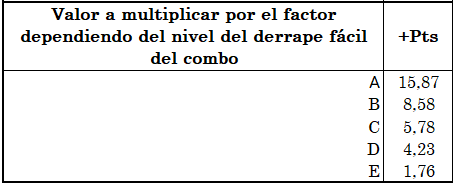
5. Una vez con todos los datos, obtendremos el valor base del combo como el resultado de sumar a la puntuación base del derrape más alto (1) el valor resultante de multiplicar el factor del punto (2) más el (3) por el valor obtenido del punto (4).
Ejemplo: Unity 2R (116,2 pts. nivel C) + Back 4R (124.72 pts. nivel C) = 124.72+(3+0,5) *5.78 = 144.9 pts.
Si el combo fuera triple habría que realizar los pasos 2, 3 y 4 teniendo en cuenta el primer y segundo derrape ejecutado por un lado, y teniendo en cuenta el segundo y tercer derrape por otro. Estas dos puntuaciones obtenidas se sumarán a la puntuación base del derrape más alto. Además, se aplicará sobre esto un 5% extra de bonificación por ser un triple combo.
Una vez calculada la puntuación base toca añadir los bonus y deducciones.
Las deducciones por la posición del cuerpo, pies y trayectoria se aplican a la base del combo y se aplican teniendo en cuenta el global de la ejecución del combo.
La deducción o bonificación de la parada se aplicará sobre la base del derrape que se para y este valor se añadirá o restará a la base del combo.
Para la deducción o bonificación por longitud se tendrán en cuenta los metros recorridos de cada derrape del combo y su bonus o deducción acorde a la tabla de metros para combos. A partir de ahí se hará un promedio ponderado con estos porcentajes y el valor base de cada derrape individual para hallar el porcentaje de bonificación o deducción a aplicar sobre la base del combo. Pongo un ejemplo:
Hacemos 2m de Back 1R + 5m Unity 2R. El back 1R tiene una base de 219.4pts y una deducción del 37.5% por 2m en combo, mientras que el Unity 2R tiene un valor base de 116.2pts y un bonus del 8%. De aquí, se saca el porcentaje promedio ponderado que es lo que se aplica a la base del combo:

Por otro lado, si en un mismo combo realizas figuras técnicas de diferentes familias, se demuestra un mayor control técnico y se otorga un bonus del 5%.
Por último, no todas las combinaciones de derrapes para formar combos serán válidas. Si se utiliza una figura de baja puntuación técnica para iniciar o finalizar una figura de mayor puntuación técnica, entonces la combinación de estos trucos contará menos que la realización del truco de mayor nivel realizado individualmente. A continuación se explican los casos en los que esto puede suceder:
- Las entradas y salidas no serán valoradas como combos, sino que serán penalizadas con un 14% sobre la base del derrape más alto. En el caso de hacer tanto una entrada como una salida en el mismo derrape, este recibirá una penalización del 21%. Como estas entradas y salidas no se considerarán derrapes, no se tendrán en cuenta para valorar el tronco superior e inferior.
- Se contará como una entrada la validación de un truco sombreado en la matriz antes de un derrape no sombreado. También se considerará una entrada la validación de este derrape pero siendo el primero a más ruedas.
- La realización de un truco sombreado con otra figura sombreada se considerará combo y sí se valorará positivamente.
- Realizar un truco sombreado con otro truco no sombreado del nivel E solo será considerado como un combo si el truco del nivel E se realiza a 5 o menos ruedas y el nombre del truco es diferente al del truco sombreado.
- Se contará como salida la validación de un truco sombreado tras un truco no sombreado, siempre y cuando este segundo no sea el mismo derrape pero a más ruedas.
- Los derrapes en nivel A y B no aumentan su nivel si se combinan con derrapes de nivel D a 8 ruedas o nivel E.
- La validación de un derrape más de una vez en la misma pasada pero siendo el segundo a más ruedas no será considerado como combo y, por lo tanto, no aumentará la puntuación del derrape.
- Con independencia de la finalización de un derrape, se contará como Non-Stop si dicho derrape que se para está considerado como una salida; o si se hace una combinación y el último derrape no se considera como parte del combo acorde a los últimos dos puntos.
Penalizaciones
Tras esto ya solo quedaría hablar de las penalizaciones y consideraciones técnicas extra:
- Si hay una caída dentro de la zona de derrapes o el patinador toca con cualquier parte de su cuerpo o del patín (a excepción de las ruedas) el suelo, el derrape se considerará como nulo.
- Si en una pasada el patinador hace varios intentos de derrapes, solo se considerará el primero (por ejemplo: intenta un Back, no le sale, pero como hay espacio aún lo vuelve a intentar).
- Si en una ronda el patinador repite el mismo derrape con la misma combinación de ruedas, solo el intento que aporte mayor puntuación será tomado en cuenta. Si el derrape repetido se encuentra dentro de un combo solo se eliminará del cálculo el derrape repetido (a efectos prácticos, se pondrá un 1 en metros a ese derrape dentro del combo para que así el programa solo tenga en cuenta el otro derrape).
- Hay que validar un mínimo de 2 familias en una ronda. Si no se cumple, el patinador quedará relegado a la última posición del grupo o clasificación, y solo se comparará su puntuación con otros patinadores que también tengan dicha penalización.
- Por otro lado, hay que aclarar un par de aspectos sobre la cantidad de ruedas utilizadas para la realización del derrape, ya que puede conllevar en una deducción de su valor. Me explico:
- Los derrapes en los que el pie de apoyo está rodando (Acid, Soul, Ern-Sui…), si se realizan a 5 ruedas, el pie que va a 1 rueda será el pie de apoyo. De no ser así, se considerará que el derrape es peor que su forma más básica. Es decir, se puntuará como un derrape a 8 ruedas con una penalización máxima (M) de inestabilidad de pies.
- Los derrapes en los que el segundo pie (pie de atrás) derrapa o frena (Magic, Parallel, UFO, Unity…) se deben realizar a 2 o a 8 ruedas. En caso de ser realizados a 5 ruedas, se considerará que el derrape está peor ejecutado que su forma más básica. Es decir, se puntuará como un derrape a 8 ruedas con una penalización máxima (M) de inestabilidad de pies.
Una vez explicados los requisitos técnicos del reglamento español, ya estaría todo lo importante comentado, pero te animo a que vayas a la web de la federación española y lo mires ahí con mayor detenimiento. Sobre todo antes de una competición, ya que lo que he escrito aquí no tiene carácter oficial.
En cualquier caso, si quieres que explique alguna cosa del reglamento en particular porque tienes dudas o porque no queda claro, dímelo en los comentarios y haré un artículo resolviéndolas.
Por último, aquí puedes descargarte el programa que se usa en las competiciones españolas para que puedas probarlo y ver qué puntuaciones obtendrías 😊
International regulations
*The purpose of this article is purely informative and has no official validity. I only seek to provide more information and context about the changes we have made to the Spanish regulations for slides and try to explain it in a simplified way, giving my opinion at certain times. If you want to consult the official documents, you can click on the links throughout the article.
In this post, I want to focus mainly on the Spanish regulations, but to have context on why we have introduced changes in Spain, we must consider the international regulations. Moreover, this is still being used in the rest of the world.
You can see the complete international regulations here.
Why do we have different slide regulations in Spain?
Our discipline, like most sports, evolves and changes over time and, although at the international level the regulations have remained unchanged since 2020, in Spain we have seen the need to expand and specify certain parts of the slide discipline according to current needs, as well as improve sections that were ambiguous.
All these changes in the regulations and the matrix have been always made in such a way that there is reasoning behind each decision and the everything that has been changed can be explained. Furthermore, the objective with these regulations is to maintain the essence of how judging is done, only seeking to eliminate ambiguities with the changes that have been added and aiming for objectivity thanks to the computer program that has been created for judging. Because in the end, a judge should be a tool that is responsible for applying the regulations, they should not be able to have an opinion because a competition should give the same result regardless of who judges it, if it is in accordance with the applied regulations.
Inconsistencies in the international matrix
If you observe the international matrix, you will see that there are many things that don’t quite add up:
- First, there are the families: More or less, it makes sense how the slides are separated, but there are some details that spoil the approach of this matrix.
- In family 5 we have the Parallel and Cross Parallel (tricks where both feet slide) along with the Unity and Savannah (tricks with the front foot sliding and the back foot braking). In my opinion, the Parallel is unnecessary there because the main foot in that slide is the front one, which is on the inside edge, while in the other three the main foot is on the outside edge, but perhaps a reason could be understood where all four slides make sense together. However, what doesn’t make sense is putting Unity / Savannah and Acid / Cross Acid in different families, when the former directly arise from the latter. The same goes for placing the Parallel in a different family from Soul and Powerslide.
- I think the idea when separating slides by families should be that the slides of each family have a common and unique characteristic of that family, in addition to the technique of simpler slides of each family being able to be used for higher slides of that same family.
- Level of certain slides: The other inconsistency I see in the international matrix is when comparing the difficulty of certain slides. I give examples:
- There are slides that are very close together regardless of the number of wheels: The flat Eagle is put as more difficult than the heel Eagle and one and two lines respectively from the other versions of the two-wheel Eagle; the same happens with the Cross Sui on 5 wheels and the 2-wheel versions, which are all together, or with the Cowboy or Cross UFO, where the flat version is only one or two lines from the first 2-wheel version. This without counting the question of whether we should separate the different 2-wheel versions of the slides into different lines. In some slides I think it’s clear that a certain combination of wheels is more difficult than another, but in most cases it depends more on the person than on the slide itself, and I don’t think there’s enough evidence to separate those versions, besides making it difficult to read and understand the matrix.
- There are slides that are NOT more difficult than others: The most obvious case is that of Magic and Parallel. Due to the foot position of both slides, it’s clear that Magic is simpler because having both feet tilted inward (i.e., each foot tilted to one side) makes it much harder to fall backward if you place your body very far back, plus the support surface is much larger because the feet are further apart. However, in Parallel both feet are tilted to the same side (thus sliding both feet on the inside edge the first one and outside edge the foot behind) and the feet have to be closer together. This means that if you tilt your feet too much or throw your body too far back, you’re left with no support to put your weight on, and you fall. This could be «defended» by saying that you can’t compare the difficulty level between one family and another, but honestly, what’s the point of making a matrix with several families if you can’t compare all the slides to each other?
- Something similar happens within the same family with the flat Cross UFO and the 2-wheel Eagle, to give an example.
- The matrix is based on 2-meter slides, which is the minimum, but I think sliding 2 meters of any slide doesn’t demonstrate mastery or control over it.
Spanish matrix and reasoning
Last year (2024), the Spanish matrix was changed and a matrix with only 4 families was created. Each family has a reason for being:
- Family 1 is for slides done sideways with the main or dominant foot sliding on the inside edge.
- Family 2 is for slides done sideways with the main foot sliding on the outside edge.
- Family 3 is for slides executed with the body facing forward, either forward or backward, and with legs open (flexibility to open the hip).
- Family 4 is for frontal slides with closed legs (flexibility to close the hip).
We have separated each family into 5 levels of difficulty, making each level jump coincide with a considerable increase in the level of slides executed (this non-linear increase in difficulty can be seen by observing the score, but I think explaining the value of these scores is too technical at a mathematical level). The difficulty does not follow a linear increase because after certain slides or certain knowledge, it doesn’t always take the same effort to learn the next trick.
This way, in level E are all the slides considered basic on 8 and 5 wheels, and most also on 2. In level D there will be simple (but not basic) slides on 8 wheels and the rest of basics on 2. In level C you can find intermediate difficulty slides (Back, Fast, Cross Sui, Eagle, Cowboy) and 2-wheel versions of simple slides (Unity, Savannah, UFO, Parallel). In level B are difficult slides and, finally, in level A are the slides that have a very high difficulty, either due to their flexibility and/or technical difficulty.
Moreover, if you’re learning to slide, you can base yourself on this matrix to see which tricks make sense to learn from the slides you already know how to do. For example, if you don’t know how to do a 2-wheel Acid, I don’t recommend at all trying to learn a 2-wheel Unity, even if you already know how to do a flat Unity, because the 2-wheel Unity is very influenced by these two previous slides.
On the other hand, the 2-wheel versions of each slide are all together, according to the explanation I’ve given in the previous section.
Finally, this matrix is based on 4-meter slides on slippery ground assuming you maintain controlled body and arms during execution and where you reduce speed considerably, almost coming to a stop, as it has been considered that with these criteria you need to have some mastery of that slide.
Spanish regulations
To avoid extending more than necessary, I’m not going to compare both regulations this time as I did with the matrices, but I’m only going to explain the Spanish regulations. In any case, you can read the 4 pages of the international regulations in the slides section (section 9) to see the differences here later. Nevertheless, I repeat, what is described here is only for informative purposes and sometimes I provide and have provided my opinion. It has no official validity, and I only seek to make it easier to understand.
If you read each point of the regulations, the first 4 refer to the competition area, the composition of the groups, the development of the competition, and the best slide. As these sections don’t have as much to do with the technical part and are already summarized in the book, I’m not going to repeat the same here.
Technical Requirements and Judging Program
As mentioned in the book, starting from 2025 in Spain, judging will be done using a program that assigns numerical values to participants’ performances. This way, skaters in the same group will no longer be compared, but will be scored numerically and ranked based on these scores.
To judge each slide, several characteristics will be evaluated, but first, I’ll define what a standard slide is, as the score for each slide in the matrix is given according to these values, and from there, points will be added or deducted based on these criteria.
A slide is considered standard when it is performed for 4 meters (if it’s a combo, the standard length is 3 meters for each slide) with stability in body and feet, in a straight line, and significantly reducing speed, almost coming to a stop at the end. This means that body position, feet position, and trajectory will not receive a bonus, as these are expected to always be correct.
Once explained, I’ll detail each of the characteristics:
- Body Position: Both chest and arms must remain stable during the execution of the slide. Three possible states are defined:
- Good trunk control (B): when the same position is maintained throughout the slide.
- Okay / Mediocre upper trunk control (R): when arms or body move erratically after entering the slide.
- Poor trunk control (M): when arms and body move erratically after entering the slide.
- Slide Trajectory:
- Good (B): the slide is executed in a straight line.
- Okay / Mediocre (R): when the slide is 5 or more meters and deviates to the lateral edge of the track, or when it’s less than 5 meters and follows a curved trajectory.
- Poor (M): when the skater is forced to end the slide because they leave the track from a side or when the slide trajectory is less than 5 meters and deviates to the lateral edge of the track.
- Foot Position: Pay attention to the placement of the feet and any uncertainties that may arise in the edge during execution. We also have 3 options:
- Good (B): feet are in the slide position and it’s clearly identifiable, plus there’s leg locking if there should be.
- Okay / Mediocre (R): when the slide is on 2 wheels and one foot momentarily touch with more wheels once or twice the ground; or when legs are not locked in slides that should be; or when the foot bounces, but it’s clear that the skate’s inclination is correct.
- Poor (M): when the slide is on 2 wheels and one foot momentarily touch with more wheels the ground more than twice or stays on more than two wheels for a meter or more; when the foot bounces and/or it’s not clear which edge the sliding or braking skate is on.
- Stopping: It demonstrates greater skill and control and, as in the previous characteristics, three options are defined:
- Full Stop (F): provides a bonus when stopping in the slide position and maintaining it for at least one second.
- Stop (S): doesn’t modify the slide score as it’s considered standard. It’s a «stop» when speed is considerably reduced, without reaching a «Full Stop» and the skater doesn’t continue their trajectory forward at the end of the slide, i.e., they exit from the side of the slide area skating.
- Non-stop (N): a deduction is given when the slide ends abruptly and/or exits with speed and forward momentum. It’s also considered «non-stop» if the slide ends outside the slide area.
- Length. The minimum distance for a valid slide is 2 meters and only the distance slid in the slide area will be considered. We’ll differentiate between individual slides and slides within a combo:
- Individual slides: 2 or 3 meters will have a deduction; 4 and 5 meters will be considered standard and won’t add or subtract points; while slides of more than 6 meters will have a bonus.
- Slides within a combo: in this case, there’s a penalty if that slide within the combo is 2 meters. If it’s 3 meters, it will be standard, and if it’s 4 or more meters, it will have a bonus.
Images with tables of the bonuses and deductions I’ve just mentioned are attached below.
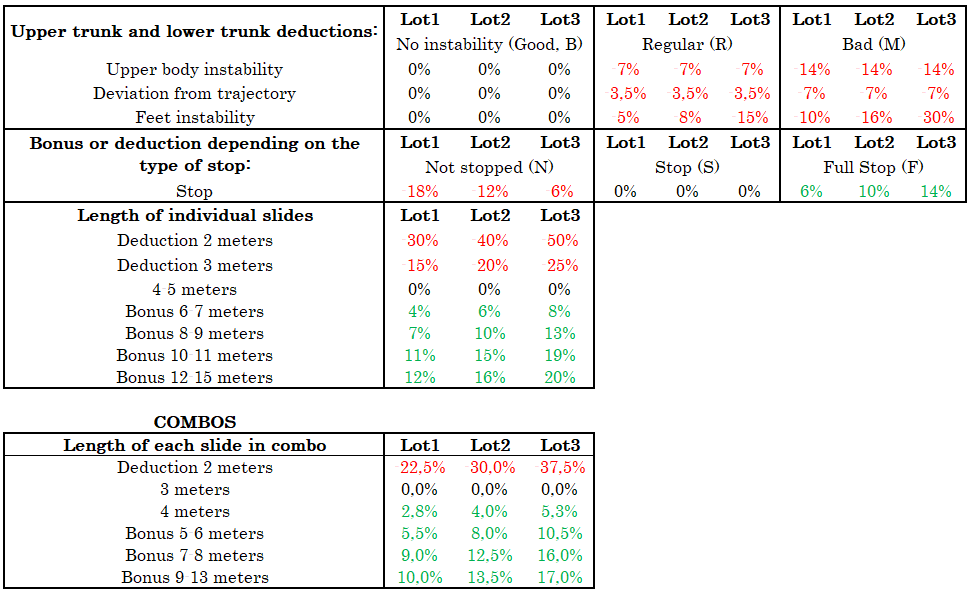
If you observe them, you’ll see that the percentage varies depending on the lot, but… what is a lot?
Lots
As each slide has its own position, not all slides are equally easy or difficult to stop, to make longer, or to position the feet correctly, so for each of these three characteristics, the slides have been separated into 3 lots, each with its explanation.
For foot instability, the slides in each lot respond to the following definitions:
- Lot 1. Slides where one foot skates and/or the slide is performed on 8 wheels (if there are no doubts about the edge).
- Lot 2. 8-wheel slides where flexibility can cause the foot position to be wrong, and those that don’t meet criteria 1 or 3 (especially 2-wheel slides) or meet aspects of both 1 and 3.
- Lot 3. Slides where it’s difficult to define the edge or that can create many doubts about the foot position.
For stopping, we define the following 3 lots:
- Lot 1. Slides where one foot skates or slides performed on 8 or 2 wheels where each foot is tilted to one side.
- Lot 2. 8-wheel slides that require considerable flexibility and slides on 8 or 2 wheels with both feet tilted to the same side, and the rest of the slides that don’t fit in the other two lots.
- Lot 3. Slides performed on 1 foot; performed with feet placed at the same level, i.e., in a single line; on 2 wheels with difficulty maintaining the position still and/or that require a lot of flexibility to perform.
For length, we define the following 3 lots:
- Lot 1. Slides where one foot skates or figures performed on 8 wheels where each foot is tilted to one side.
- Lot 2. 2-wheel slides with one foot tilted to each side; slides with one foot skating on 2 wheels and difficult to maintain; 8/4-wheel slides with all feet tilted to the same side.
- Lot 3. Slides executed on 1 wheel; 2-wheel slides that due to their position or flexibility contrary to the natural position of the body are difficult to maintain; or 4/8-wheel figures that require a lot of balance to be maintained and there’s only one line of support.
Combos
Finally, an extra section must be dedicated to discussing combos and their particularities when judging them. As we’ve already mentioned, it’s considered a combo when each slide that composes it has a minimum of 2 meters (3 meters will be considered standard) and the transition between both is less than 2 meters.
To calculate the score of a combo, we must first obtain the base score and then apply the deductions. To calculate the base score of the combo we will follow these steps:
- We’ll use as reference the base score of the highest individual slide.
- We look for the level difference (number of rows) between the highest and lowest slide. Depending on the number of rows, we’ll take the corresponding factor according to the following table:
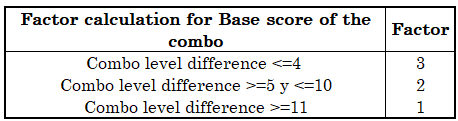
- To this value, we add 0.5 if the combo is ascending (the slide performed first is lower in the matrix than the second slide) or subtract 0.5 if it’s descending (the slide performed first is higher in the matrix than the second).
- Now we look for the difficulty level of the least difficult slide in the following table.
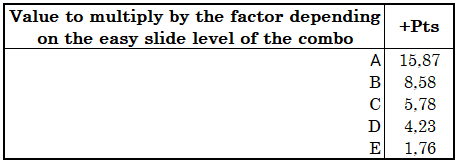
- Once we have all the data, we’ll obtain the base value of the combo as follows:
We’ll add to the base score of the highest slide (1) the resulting value of multiplying the factor from point (2) plus (3) by the value obtained from point (4).
Example: Unity 2 (116.2 pts. level C) + Back 4 (124.72 pts. level C) = 124.72+(3+0.5)*5.78 = 144.9 pts.
If the combo were triple, steps 2, 3, and 4 would need to be done considering the first and second executed slides on one hand and considering the second and third slides on the other. These two obtained scores would be added to the base score of the highest slide. Additionally, an extra 5% bonus would be applied for being a triple combo.
Once the base score is calculated, it’s time to add the bonuses and deductions.
Deductions for body position, feet, and trajectory are applied to the combo base score and are applied considering the overall execution of the combo.
The deduction or bonus for stopping will be applied to the base of the slide that stops, and this value will be added to or subtracted from the combo base score.
For the deduction or bonus for length, the meters covered by each slide in the combo will be taken into account and their bonus or deduction according to the length table for combos. From there, a weighted average will be made with these percentages and the base value of each individual slide to find the percentage of bonus or deduction to apply to the combo base. Here’s an example:
We do 2m of Back 1-Wheel + 5m Unity 2-Wheels. The Back 1-Wheel has a base of 219.4pts and a deduction of 37.5% for 2m in combo, while the Unity 2-Wheels has a base value of 116.2pts and a bonus of 8%. From here, the weighted average percentage is calculated, which is what is applied to the combo base:
On the other hand, if in the same combo you perform technical figures from different families, it demonstrates greater technical control, and a 5% bonus is awarded.
Lastly, not all combinations of slides to form combos will be valid. If a figure of low technical score is used to start or end a figure of higher technical score, then the combination of these tricks will count less than performing the higher-level trick individually. The cases where this can happen are explained below:
- Entries and exits will not be valued as combos, but will be penalized with 14% on the base of the highest slide. In the case of doing both an entry and an exit in the same slide, it will receive a 21% penalty. As these entries and exits will not be considered slides, they will not be considered to assess the upper and lower trunk.
- It will count as an entry the validation of a shaded trick in the matrix before a non-shaded slide. It will also be considered an entry the validation of this slide but being the first on more wheels.
- The performance of a shaded trick with another shaded figure will be considered a combo and will be valued positively.
- Performing a shaded trick with another non-shaded trick at level E will only be considered a combo if the level E trick is performed on 5 or fewer wheels and the name of the trick is different from the shaded trick.
- It will count as an exit the validation of a shaded trick after a non-shaded trick, if the second is not the same slide but on more wheels.
- Slides at level A and B do not increase their level if combined with slides of level D on 8 wheels or level E.
- The validation of a slide more than once in the same run but with the second on more wheels will not be considered a combo and, therefore, will not increase the slide’s score.
- Regardless of the completion of a slide, it will be counted as Non-Stop if said slide that stops is considered an exit; or if a combination is made and the last slide is not considered part of the combo according to the last two points.
Penalties
After this, all that would be left is to talk about penalties and extra technical considerations:
- If there is a fall within the slide zone or the skater touches the ground with any part of their body or skate (except for the wheels), the slide will be considered null.
- If in a run the skater makes several slide attempts, only the first will be considered (for example: tries a back, doesn’t succeed, but as there is still space tries again).
- If in a round the skater repeats the same slide with the same wheel combination, only the attempt that provides the highest score will be taken into account. If the repeated slide is within a combo, only the repeated slide will be removed from the calculation (for practical purposes, a 1 will be put in meters for that slide within the combo so that the program only considers the other slide).
- A minimum of 2 families must be validated in a round. If not met, the skater will be relegated to the last position of the group or classification, and their score will only be compared with other skaters who also have this penalty.
- On the other hand, a couple of aspects about the number of wheels used for performing the slide need to be clarified, as it can lead to a deduction of its value. Let me explain:
- In slides where the support foot is skating (Acid, Soul, Ern-Sui…), if performed on 5 wheels, the foot that goes on 1 wheel will be the support foot. If not, it will be considered that the slide is worse than its most basic form. That is, it will be scored as an 8-wheel slide with a maximum penalty (M) of foot instability.
- Slides where the second foot (back foot) slides or brakes (Magic, Parallel, UFO, Unity…) must be performed on 2 or 8 wheels. If performed on 5 wheels, it will be considered that the slide is worse executed than its most basic form. That is, it will be scored as an 8-wheel slide with a maximum penalty (M) of foot instability.
Once the technical requirements of the Spanish regulations have been explained, all the important aspects would be covered, but I encourage you to go to the Spanish federation’s website and look at it there in more detail. Especially before a competition, as what I have written here has no official character.
In any case, if you want me to explain anything in particular about the regulations because you have doubts or because it’s not clear, let me know in the comments and I’ll write an article resolving them.
Finally, here you can download the program used in national competitions so you can try it and see what scores you would get 😊

0 comentarios